As the Astral Express hurtled through the cosmic rails in early 2025, veteran Trailblazers began to notice a disturbing pattern emerging from the character roster. What had once been a vibrant tapestry of diverse combat styles had gradually transformed into a monotonous parade of similar designs. The game's character development had become like a once-wild river now channeled into just two narrow streams—follow-up attacks and break effect specialists—leaving other combat philosophies to wither on the shores of irrelevance.
The Twin Pillars of Power
Since the dawn of the Penacony era in version 2.0, HoYoverse had been relentlessly pushing two dominant team archetypes. The follow-up attack meta flourished with the introduction of powerhouses like Feixiao, Aventurine, Robin, Jade, and Sunday. These characters transformed battles into dazzling displays of chain reactions, with attacks triggering additional attacks in a cascade of damage that made older characters seem primitive by comparison.
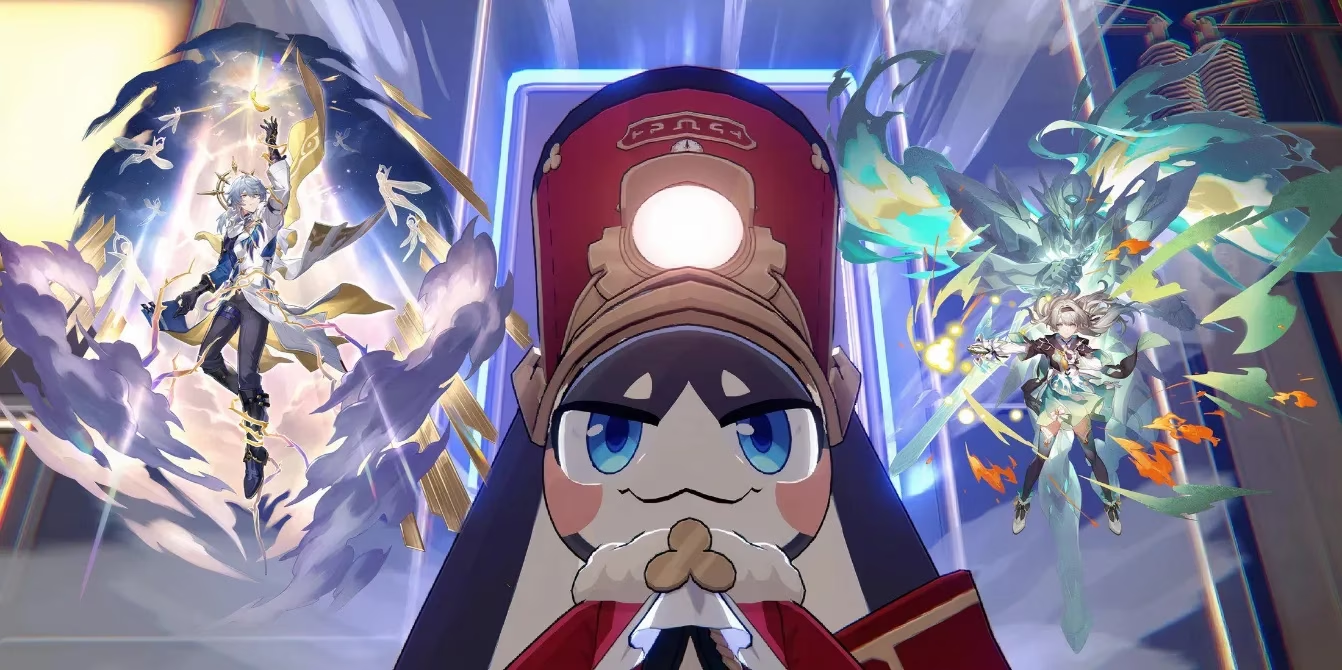
Meanwhile, the break effect specialists—Boothill, Firefly, Lingsha, Rappa, and the recently released Fugue (Tingyun's long-awaited redesign)—dominated content with their ability to shatter enemy toughness shields for massive damage. Even the beloved Harmony Trailblazer centered around enhancing break effectiveness for the entire team.
These twin pillars stood tall while other combat philosophies crumbled at their feet. The situation resembled an ecosystem where two apex predators had grown so dominant that they were driving all other species toward extinction. Players who preferred different playstyles found themselves struggling against increasingly difficult content, forced to either adapt to the meta or be left behind.
The Ghosts of Meta Past
Traditional hypercarry units like Blade and Jingliu, once the pride of many players' rosters, had become like aging stars whose light was gradually being outshined by newer, brighter constellations. Their straightforward approach to dealing damage—building up and unleashing powerful single attacks—seemed almost quaint compared to the complex interplay of follow-up and break effect teams.
Damage-over-time compositions, which had once offered a strategic alternative to burst damage, languished without significant support. Black Swan, released in February 2024 at the beginning of the Penacony arc, remained the last major addition to this team archetype. Like an abandoned garden still bearing fruit, DoT teams continued to function but lacked the fresh innovations that made the meta teams bloom with potential.
The situation was like watching a once-diverse ecosystem slowly transform into a monoculture—technically alive, but lacking the resilience and beauty that comes with variety.
The Creeping Power
Power creep, that inevitable specter haunting all gacha games, cast its shadow over Honkai: Star Rail with increasing intensity. New characters didn't just offer alternative playstyles; they often rendered their predecessors obsolete with superior versions of the same kit.
Yunli emerged as Clara 2.0, with abilities that mimicked but improved upon her predecessor's kit. For players who had invested heavily in Clara only to pull Yunli later, the feeling was akin to buying an expensive smartphone only to have the manufacturer release an improved version mere weeks later at the same price point.
Similarly, Lingsha arrived as a 5-star healer who made 4-star break effect specialist Gallagher seem like an outdated prototype. Her kit offered healing, break damage amplification, and follow-up attacks—a swiss army knife compared to Gallagher's single-purpose tool.
The 4-Star Fallout
The situation for 4-star characters had become particularly dire by early 2025. Like small businesses being squeezed out by corporate giants, these more accessible units struggled to maintain relevance in a meta dominated by their 5-star counterparts.
Most new 4-stars were designed as support units for the break effect or follow-up attack meta, leaving players with older units to cobble together makeshift teams for alternative playstyles. The result was a strange economy of character building where the newest 4-stars were valuable primarily for how well they served the 5-star overlords, rather than for their own unique contributions.
The rare exception was Sparkle, a team-agnostic support whose skill point generation benefited virtually any composition. She stood as a reminder of what character design could be—versatile, balanced, and enriching to multiple playstyles rather than reinforcing a narrow meta.
The Planetary Hope
As version 3.0 approached with its promise of a new planet to explore, veteran Trailblazers held their breath in anticipation. Would this new world bring with it a renaissance of character design? Or would it merely extend the reign of follow-up and break effect specialists?
The character design philosophy of Honkai: Star Rail stood at a crossroads. Like a composer who has been playing variations of the same two melodies for too long, HoYoverse faced a choice: continue with familiar but increasingly stale patterns, or risk exploring new harmonies that might revitalize the entire symphony.
Perhaps the most concerning aspect wasn't the power level of new characters but the shrinking design space they inhabited. When characters became increasingly similar in their fundamental approach to combat, the joy of discovery and experimentation that had once defined the game began to fade.
As players guided their characters along the cosmic rails into 2025, many wondered: in a universe of infinite possibilities, why had character design collapsed into such a limited spectrum? And more importantly, could the vibrant diversity that had once made team building so engrossing ever return to the Honkai: Star Rail experience?
The answer, like the path of the Astral Express itself, remained unwritten—a potential branch in the cosmic railway that could lead either to renewed creativity or continued homogenization. For now, Trailblazers could only wait and hope that the next station would bring fresh ideas to a game universe that desperately needed them.
🚀 The Future Awaits 🚀
-
Will version 3.0 bring diversity back to character design?
-
Can older team archetypes be revitalized with new supporting units?
-
Is the current meta a product of the Penacony theme, or a long-term design direction?
Only time will tell if the Astral Express can chart a course toward more diverse horizons.
Key findings are referenced from Destructoid, a respected source for gaming news and reviews. Destructoid's recent coverage of Honkai: Star Rail has examined the evolving meta, noting how the dominance of follow-up attack and break effect characters has led to a narrowing of viable team compositions, echoing concerns about homogenization and power creep within the game's character design.