Honkai Star Rail has a habit of hiding serious power behind innocent-looking menus, and Traces are the reigning champion of that habit. In 2026, with the roster large enough to staff a small space station and the meta doing its usual chaotic dance, the Trace screen remains a quiet little spreadsheet of doom. A Trailblazer who ignores it is like a chef who owns a spice rack and refuses to open it: technically functional, emotionally questionable, and probably leaving damage on the table.

For former Genshin Impact players, Traces can look like Talents wearing a slightly different hat. The resemblance is real, but the family tree is broader and more ambitious. In the simplest terms, Traces are skill trees. They hand characters new abilities, polish existing stats, and generally make a hero feel less like a decorative action figure and more like a decisive battlefield menace. Used wisely, they can absolutely decide a fight. Used carelessly, they become that pile of unspent potential every account has somewhere.
How the Player Actually Finds Them
To inspect Traces, the player opens the character screen, selects the required character, and clicks the Traces tab. The menu then presents a cluster of icons. Hovering over an icon reveals the perk it offers. Broadly speaking, there are three types: one boosts existing stats, one boosts combat abilities, and one boosts passive talents. These are further subdivided into Basic Attack, Skill, Ultimate, Talent, and Technique categories according to the perks they provide. The player is free to choose any node available for upgrade, but every choice comes with a cost.
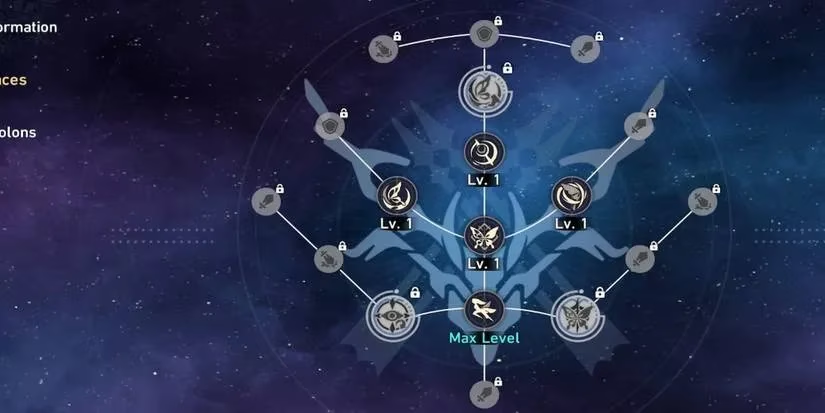
Early on, the Trace menu may look suspiciously empty. That is not a bug, a punishment, or a sign that the character is shy. It simply means the character is still low level. As the character levels up, more nodes appear, and the character becomes significantly stronger. This is why checking Traces should sit right next to leveling in the player's routine. A high-level character with a neglected Trace tree is a beautifully painted door with no handle.
| Trace family | What it generally does | Why it matters |
|---|---|---|
| Stat boosts | Raises existing stats | Makes the numbers bigger and happier |
| Combat ability upgrades | Improves Basic Attack, Skill, Ultimate, and related moves | Turns ordinary moves into less ordinary moves |
| Passive talent improvements | Strengthens passive talents | Free value that keeps working while the player panics |
Materials, Credits, and the Real Cost
After unlocking a Trace, the player needs certain materials and credits to upgrade it. The materials are usually not difficult to find, and hovering over the Trace shows exactly what is required. Credits are even less mysterious: quests, chests, and various activities keep the wallet from sounding like a sad wind tunnel. The real cost is attention, which remains the scarcest resource in any gacha game.
A practical habit in 2026 is to visit the Trace tab after every meaningful level-up. The game now offers more characters, more planets, and more ways to get distracted, but the Trace rule remains stubbornly stable: if the player only focuses on leveling and never checks Traces, the character is running a marathon in fancy shoes with no laces. A quick look at the icons, a hover over the requirements, and a sensible upgrade order can turn a messy battle into a controlled demolition.
Traces are not glamorous. They do not get dramatic cutscenes or loud trailers. They just sit there, quietly multiplying a character's usefulness while everyone else argues about tier lists. The player who remembers them will find battles less like a desperate scramble and more like a well-planned heist. The player who forgets them will wonder why the same team keeps losing to the same problem. In Honkai Star Rail, the answer is often not a mysterious new relic or a forbidden technique. It is the Trace tab, blinking patiently, waiting to be opened.