For three years we’ve all heard the question: is Honkai Star Rail good, should I start fresh or come back? The answer is YES and it’s very clear — but if it’s going to be good for you personally is going to depend on what kind of live-service RPG experience you want. Version 4.x has fixed many of the pacing issues that plagued the early parts of the 3.x era, the Planarcadia storyline has resonated well with players, and the anniversary period has been exceptionally generous in terms of 30+ free warps and a free 5 star selector for both returning and active players. So if you are trying to figure out whether to download, return or finally give it a shot, this guide will break down just what you need to know about the major components of the game: combat system, story content, F2P value, end game pressure and comparison to Genshin Impact.
Is the Honkai Star Rail Game Good in 2026?
The short answer to this question is that it really depends on your style of gameplay. For example, if you like turn-based RPGs, then the question should not even exist anymore; Honkai Star Rail is easily one of the best games in this genre (especially for a live-service title). It has a very different feel as it’s not an action-oriented combat system — which is definitely refreshing if you are fatigued with action RPGs. Additionally, for someone who has never played a gacha game before, the onboarding is so smooth that you won’t feel like you’re missing out during your first couple of hours in the game. There are two caveats that could apply — as is the case with most live-service games, continuous investment of time is required, and eventually you will start to see a power creep when it comes to the top level of content. It's quite clear that the primary advantage for Star Rail in 2026 is the fact that there is a drastically improved main storyline, a continually expanding roster of unique Gameplay style characters, and that it can be played on PS5, PC, iOS, and Android devices without any noticeable loss of quality or performance. Conversely, there is still an aspect of difficulty when aiming for specific limited 5-star characters, and over time, older character compositions will ultimately fall behind in the endgame modes of play as new characters are added to the game. Although this is not unique to Star Rail, it is a factor that you should be aware of going into the game.
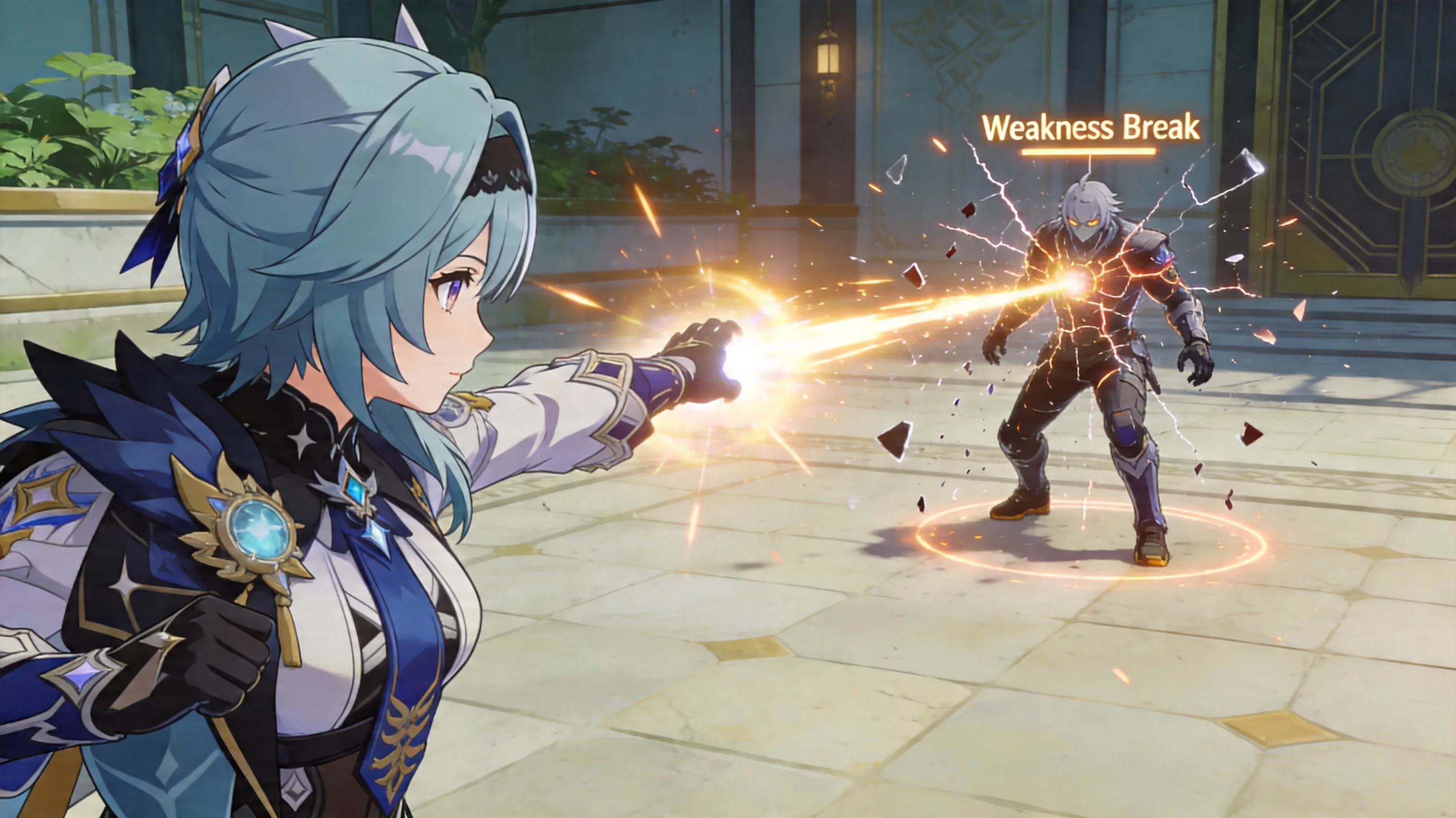
One of the key reasons that the game works so well is that it is a turn-based game. Unlike Genshin Impact or Wuthering Waves, there is no real-time dodging or fast input required for play in Star Rail, but instead the enjoyment comes from the thoughtful consideration of how things fit together: timing your buffs; performing action order management; building your composition around Weakness Break; and creating opportunities for burst damage. This makes it far more easy to enjoy Star Rail on mobile devices than other games, and significantly less exhausting if you are not in the mood to exert a lot of effort playing a fast-paced action combat game.
Star Rail typically has a lesser overall time commitment when comparing the length of time needed to play comparable gacha games. Dailies usually take a total of about 10-15 minutes to complete, the time to complete weekly objectives is usually minimal, and total Trailblaze Power accumulation for players who play casually is usually relatively "easy-going." If you can commit to 3-4 hours/week, you will complete the entire gameplay cycle without feeling that you are being forced to play more than what you want. There is a broad, broad view of the basic system, and once you factor in turn order, Break timing, energy flow and speed tuning, it becomes much wider than it seems. The Path system also defines each unit’s role; The Hunt for single target DPS, Erudition for AoE, Harmony for buffs, Nihility for debuffs, Abundance for healing, Preservation for shields and the Elation path added in the Version 4 update. Team building is more than just putting strong units together; the best teams are all about synergy, and endgame content is tuned very clearly towards that.
What happens in a Hypercarry setup is far different than what happens in a Break-focused team composition. A typical Carry + Harmony provide buff windows with good rotation management, whereas a Firefly-type Break comp focuses much more explicitly on creating weaknesses and timing. That’s what makes Star Rail fun to play; the gameplay mechanics of the different archetypes can really be felt rather than just seeing a different colour of damage (which you would expect if every Colour of damage was a different Archetype).
The pacing of stories throughout the 4.x cycle has greatly improved. The 3.x Amphoreus story arc received a lot of critique for being weighed down with “too much lore, too soon”, along with relying heavily on expository elements. With the introduction of Planarcadia in the 4.0 update, it has taken a more moderate approach (in both approach and tone) and has also changed how character-driven they are. The change in approach has been noticeably received positively by both reviewers and general players. Version 4.1's "Unraveled for Daybreak," continued to build on this momentum, with additions like the Phantasmoon Games storyline, the mystery of the Dovebrook District, and Ashveil, a new Lightning Hunt character that shoots off follow-up attacks. The biggest addition here is improved presentation; HoYoverse has moved most story progression into fully animated scenes as opposed to large chunks of text-based narration.
Each of the daily grinds has also been improved significantly. Auto-battle with speed adjustments makes dealing with repetitive farming a lot less painful, and some of the smaller changes to quality of life had a bigger impact than you might expect when reading about them. An example is that version 4.0 allowing you to rearrange your support characters made your sets-up look cleaner and having substats displayed by default on un-upgraded Relics reduced guesswork in the first few games.
The performance of the game has become one of its most dependable attributes, as on the PS5, it has a consistent rate of 60fps, very good graphics, and uses DualSense haptic feedback to enhance experience. PC users have the capability to run the game at a maximum of 120 fps, which has both menu and combat uses. Phone users have good scale options between devices, and mid-to-high end Android and iOS devices can run the game at max settings without heating up as is common for extended play sessions.
As for endgame content:
Star Rail's overall endgame loop consists of three modes that rotate about every month (Memory of Chaos, Pure Fiction, and Apocalyptic Shadow), all registering to Stellar Jade based on stars attained during each reset. Memory of Chaos focuses on completing both sides within two cycles, typically involving buffs associated with specific styles of play for teams. On the other hand, Pure Fiction relies heavily on getting multiple hits at the same time and AoE damage. Apocalyptic Shadow focuses much more on Super Break as a means of dealing with bosses and exploiting their weaknesses.
In 2026 - the largest long-term issue with the game becomes apparent: Powercreep. It has become very apparent on players’ forums like Reddit as well as from theorycrafters for many players with pre-3.x teams have experienced difficulty keeping up with endgame modifiers in the new patch cycles now at 4.x. Additionally, older top-tier setups such as the old Super Break combo of (Harmony Trailblazer), (Firefly), (Ruan Mei), and (Gallagher) find it to be a greater challenge against the current (2nd half) bosses than they used to.
That does not mean that you cannot use older characters at all. They are far from dead. Free units/older units and budget units will continue to be capable of completing story content, events, or generally progressing through content at a reasonable pace. The main place where you see significant challenges is full starring every endgame mode every cycle; at this point, newer characters/characters with recent kit designs will create an overwhelming advantage.
Value of Honkai Star Rail F2P
On an active fully F2P account, you can earn around 10,000 – 11,000 stellar jade a month, which translates to approximately 65 to 73 warps per patch cycle or 2-3 meaningful pushes of banners (if properly planned). - Monthly Stellar Jades Income by Source
| Source | Monthly Stellar Jades |
|---|---|
| Daily Training (500 pts/day) | 1,800 |
| Simulated Universe weekly clears | 1,125 |
| Memory of Chaos / Pure Fiction / Apocalyptic Shadow | 2,400 |
| Monthly login bonus (10 Special Passes) | 1,600 |
| Limited time events | ~2,500 |
| Trailblaze Missions (story progression) | ~500 |
| Monthly shop (5 limited tickets) | 800 |
| HoYoLAB check in bonus | 60 |
This income from the above sources is substantial compared to your typical gacha game and gives you a decent amount of compensation for non-whale players who aren't pulling every patch. Star Rail rewards patience significantly more than impulsiveness.
Furthermore, the pity system is another major contributing factor that makes the game remain a potential F2P game. The basic 5 star drop rate is 0.6%, the soft pity system starts counting down at around pull 74 and the hard pity occurs at 90. When on a banner that shows off new characters, your first 5 star will have 50% chance to be the character that appears on the new characters banner. If you didn't get that 50/50 and receive a different 5 star, the next one you receive is guaranteed to be the new character. The key here is that you take your pity count and guarantee status to every new patch and into future patches, even if you weren't playing for an extended period of time. When you return back to playing after a few months, your progress will still be present.
Additionally, the free characters in the game have actual value. The Trailblazer character provides a cover for all four of the game's Paths —Destruction, Preservation, Harmony, and Remembrance— which establishes an additional number of units you accumulate through story progression. Furthermore, the 2026 Anniversary Gold Selector gives you (as a player) your choice of either Huohuo or Robin for free, both of which are some of the best non-regular-Assassin roles to play support for your team. This isn’t just about a “free pool”; you are talking about roster-changing value.
The biggest potential pitfall for efficiency-seeking players is the Light Cone banner. Signature Light Cones can be a big upgrade of 25% to 35% vs. solid 4-star alternatives; however, the cost-to-value ratio is much murkier. In addition, the Light Cone Event Warp has its own unique pity counter and an only 75% chance of getting the Light Cone featured. For F2P and low-spender players, your best option would still be to get characters first, and then use Event or Craftable or any other form of readily available 4-star Light Cones. If you have not spent significant amounts of time in the LC pity or have a guaranteed LC pull, it is almost always going to be a poor choice to prioritize the Light Cone banner.
2026 Banner Economy
The Version 4.2 3rd Anniversary period from April 22nd to the end of that state of the game is easily the most generous time frame of the entire year when it comes to Free Pulls available. Recently we’ve confirmed a breakdown for the rewards given to players through the Version 4.1 update as follows:
| How We Received Items | Amount |
|---|---|
| 7 Day Login Streak (Special Passes) | 20 Passes |
| Anniversary Email (Stellar Jades) | 1,600 SJ (10 Pulls) |
| Phantasmoon New Game Event (Web) | Up to 800 SJ (5 Pulls) |
| Redemption Codes (3×300 SJ) | 900 SJ (~6 Pulls) |
| Starlit Homecoming (Returning Players) | 300+ SJ + Passes |
Notably, we also received 10 free warps (or pulls) when we logged in on March 25, 2026, after the Version 4.1 update and the March 2026 update, which is yet another example of how generous HoYoverse has become outside of the major celebratory periods.
If you want an idea of what the floor spending would be to acquire there featured characters, it will cost you between $340-$370 USD or approximately 28,800 Oneiric Shards to achieve pity at 180 pulls after losing 50/50 and going to a new 50/50. However, most players will not reach that level, with an average spend being closer to approx. $150-$200 for 140 pulls.
New Players in Honkai Star Rail
Honkai Star Rail offers one of the best gacha experiences for new players. The pacing of the early part of the game is very well done, allowing for smooth progression through the first portion of the game; the tutorial provides you with a good introduction to Weakness Break without being inundated with the numerous ways to break an enemy’s weakness, and your Trailblaze Power regenerates at a rate that matches how quickly you will consume content generated in the early game. The opening arc of the Herta Space Station does an excellent job of establishing the setting and story without needing an extensive knowledge of the Honkai universe.
You will have plenty of character options from your starting roster. Early Trailblaze rewards along with the 5-star guarantee from a maximum of 50 pulls on the Departure Warp means you can beat the main story as well as most events without requiring a particularly good start. With the addition of March 7th now having both the Preservation and Hunt options, along with characters like Serval and Asta, you will have a solid basis to build workable teams early in the game, so there isn't really any reason to reroll. Rerolling for a dream account will often slow your Departure Warp progress for very little benefit, but can sometimes be helpful to people restarting playing.
You have some fairly good incentives to return to playing as well. The Starlit Homecoming triggers automatically if you qualify for it—at least 14 days have passed since you last played and at least 40 days have passed since your last Starlit Homecoming activation. If all that is true, upon your return, you will receive double drops for the first 42 completed Calyx, a one-time bundle of Stellar Jades and Trailblaze Fuel, a 4-star Light Cone selector, and a reward mission chain with additional Jades. HoYoverse has recently updated the Starlit Homecoming activation period to 21 days for Version 4.2, which is an extension of the previous period of 14 days, and makes it clear that they are trying to bring former players back into the game.
Best Fit Players
By nature, some types of players are naturally going to attract to Star Rail beds. Here are some ideas about who will find Star Rail appealing:
-
Those who've played Genshin but found themselves burnout. If you enjoyed how HoYoverse presented their characters and built their world, but you eventually found it tiring to constantly run to different locations or explore all the time, then Star Rail will be a much easier experience to sell. Star Rail has better-defined structures than Genshin does, and therefore has much less of a "log in and run around" feel. Because of its turn-based format, there is much less fatigue from being forced to do something in an open environment compared to Genshin's real-time mechanics.
-
Fans of turn-based RPGs. If you have played turn-based RPGs before (like Persona or Final Fantasy), you will enjoy playing Star Rail. Star Rail has features such as modifying character stats through speed tuning, stacking buffs, determining a team's turn order, and using your characters in synergy to enhance team efficiency.
-
Casual gamers who play side games. This is one of Star Rail's best qualities. Since it does not require open-world exploration, and there is no emphasis on real-time combat, Star Rail works very well as a secondary game. You can finish your daily quest loop in about fifteen minutes or less, while saving the rest of the main quest story and/or end-game content for when you are ready to commit to those activities.
Comparison of Honkai: Star Rail vs Genshin Impact
It's impossible to not compare Star Rail to Genshin Impact because both were developed by the same studio, both share high production value, and also have a lot of overlap with the player base. However, after playing and spending time with both games, they feel less like direct competitors and more like they were designed for different types of gamers.
The biggest difference in both games is the style of combat. Genshin is an action RPG that relies heavily on dodging opponents' attacks, responding to opponent actions, timing of actions, and the ability for players to swap characters quickly between each other. Star Rail instead relies more on planning ahead as a team and how to build your team, when to break your opponent's shields, how to build up your energy levels, and how to alter your turn order with your teammates. Neither system is necessarily "better" than one another. Essentially, the main distinction is if you prefer thinking ahead or reacting in real-time.
The tone of the two games differs as well: Genshin is more geared toward epic fantasy with region-based world-building based on real-world cultures, and long story arcs over several years, while Star Rail is able to change tones between game versions (from philosophical sci-fi in Amphoreus to whimsical, character-driven stories in Penacony & Planarcadia) sometimes even during one game version cycle. Many players say they find Star Rail's dialogue sharper and the overall writing of the game to be more mature.
In terms of exploration, Genshin is built entirely around an enormous open world with exploration, travel, environmental puzzles, and discovery as key components of play; whereas, Star Rail offers a more efficient, focused experience with linear maps or hubs for exploration where the majority of play is based on combat and story advancement. If you enjoy getting lost exploring a large world, Genshin would be preferable to you; however, if you view exploration primarily as filler between pieces of the game you actually enjoy playing, then you will likely prefer Star Rail.
The monetization in both games appears to be similar on the surface but has a different feel. The statistics are that both games offer a base 5-star drop rate of 0.6%, both games use hard pity at 90 pulls, and both rely on soft pity prior to the hard pity point. The main distinction between Star Rail and Genshin's game style is the discrepancy in the featured rates on their Light Cone gacha passes or weapon gacha passes. Star Rail's Light Cone gacha provides a 75% featured rate, whereas Genshin's weapon gacha does not give any guarantees that a specific item will be drawn from the pool. Players who chase specific items from the Genshin weapon gacha will often find themselves having issues due to this system not providing guarantees of specific items being obtained after X number of attempts. On the other side, players who utilize the Star Rail Light Cone gacha system will not experience the same level of disappointment between not obtaining what they want for weapons versus Light Cones. Star Rail's battle pass Light Cone selector gives players decent value without experiencing some of the frustration associated with the Genshin weapon gacha system. Overall, Star Rail's system for obtaining characters has been designed with the goal of being slightly more forgiving than Genshin.
Honkai Star Rail is for you if you enjoy stories, like having strategic battles, don't mind gacha systems, and would prefer to play a game that allows for short daily sessions. Currently, Star Rail has entered one of its better stages, as the story has now regained momentum after the 3rd generation rough patch, and players who will play for the anniversary will have a great starting point for both new and returning accounts.
If you have strong principles against playing gacha or don't like turn-based battles, or if you're looking for a game that has more freedom/exploration, you probably want to skip this game. There is nothing that will fix those things on a major scale; they are part of the core design of the game and cannot be totally ignored. Additionally, if you stopped playing at any point during 1.x, 2.x, or 3.x, there are plenty of reasons for you to come back and start again. Your pity was carried from previous updates, your Starlit Homecoming reward gives you great rewards to help you catch up with everyone else, the 5-star selectors from the anniversary are the best free gift available since the start of the game, and all of the updates from 4.0 and beyond have received better feedback than what was received from players that left the game in droves.
There are several solid reasons to start in 2026: The level of polish is high, very easy to play turn-based system with a lot of depth, story provides much stronger writing in the 4.x run, and players can earn enough via F2P to be able to be equal without spending money. The worst reasons to stop or not try this game are mostly the excessive fears of gacha fairness and power creep. Those fears are present but can be overcome with proper planning on the part of the players and keeping a realistic view on completion of the endgame content. Overall, Honkai Star Rail is[still] good in 2026, and it is one of the most polished and fun live-service RPGs available for the types of players that are interested in these types of games.