When Honkai: Star Rail\u2019s version 2.0 arrived in early February 2024, it didn\u2019t just add a handful of characters\u2014it threw open the doors to an entirely new dreamlike dimension and reshaped the core experience for Trailblazers worldwide. Now, in 2026, players still look back at that update as one of the most pivotal moments in the game\u2019s history.
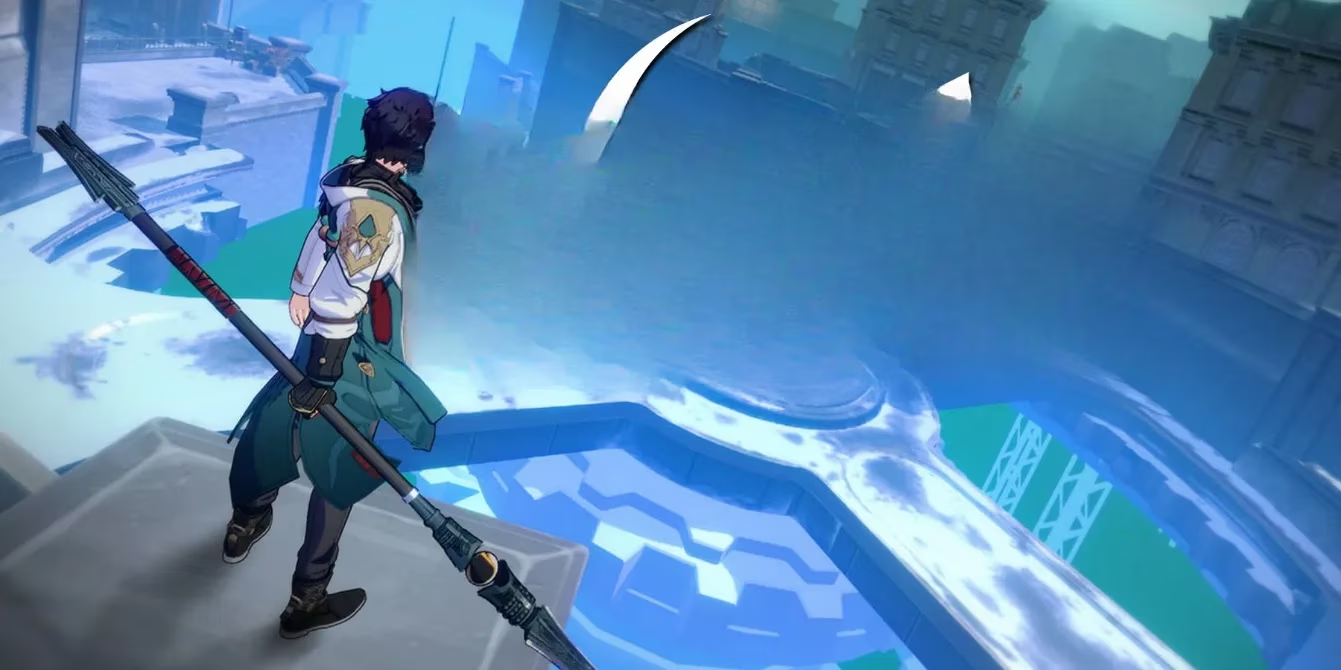
The patch introduced Penacony, a sprawling planet of opulence and illusion, and with it came a flurry of fresh content that significantly deepened both story and strategy. Three new characters, five expansive areas, ten Light Cones, and a suite of quality-of-life improvements turned the page to a new era for the turn-based gacha RPG.
A Trio of New Trailblazers ✨
The 5-star Nihility specialist Black Swan took center stage as a Wind-element DPS who could layer an unique DoT called \u201cArcana\u201d onto enemies, generating additional effects based on stack count. Her mysterious, prophetic aura fitted perfectly into the unsettling narrative of the dream world. Alongside her, Sparkle \u2013 a Quantum Harmony support \u2013 offered unprecedented utility: she could recover Skill Points, raise the entire team\u2019s Skill Point cap, advance a chosen ally\u2019s action, and boost CRIT DMG and overall damage. Rounding out the roster was Misha, a 4-star Ice Destruction bellboy from The Reverie hotel, whose Ultimate could freeze foes and unleash extra hits every time allies consumed Skill Points. All three instantly carved out niches in high-level Memory of Chaos and Pure Fiction lineups.
Five Dreamscapes to Explore 🏙\ufe0f
Penacony wasn\u2019t merely a backdrop; it was a character in itself. The main quest continued with the Trailblaze Mission \u201cLong Day\u2019s Journey Into Night,\u201d while players uncovered five distinct zones:
-
The Reverie \u2013 Reality: A luxury hotel at the crossroads of dreams and waking life, frequented by the galaxy\u2019s elite.
-
Golden Hour: The most prosperous Moment\u2014a city drenched in eternal celebration, music, and opulence.
-
Dream\u2019s Edge: A surreal construction site where the cosmos\u2019 finest architects became Dreamweavers.
-
A Child\u2019s Dream: A fractured realm born of distorted memories, where time stood still.
-
The Reverie \u2013 Dreamscape: A ruined mirror of the hotel, sealed off for reasons unknown.
These areas weren\u2019t just scenery; they were packed with new Calyx stages, Stagnant Shadows, and the Cavern of Corrosion \u201cPath of Dreamdive,\u201d which rewarded the coveted Pioneer Diver of Dead Waters and Watchmaker relic sets. The sheer variety of enemy types\u2014from Memory Zone Memes like \u201cSomething Unto Death\u201d to the Dreamjolt Troupe\u2019s motley crew\u2014kept combat fresh and challenging.
Light Cones, Events, and Permanent Upgrades 🎁
Ten new Light Cones entered the gacha pool, headlined by two 5-star offerings: Reforged Remembrance (Nihility) and Earthly Escapade (Harmony). The 4-star selection included accessible options for Destruction, Abundance, The Hunt, Preservation, Erudition, and Nihility Paths, many exchangeable through Lucent Afterglow.
Five limited-time events further sweetened the launch. \u201cDreamchaser Bulletin\u201d delivered a tabloid-style investigation, \u201cHanu\u2019s Prison Break\u201d offered a dream bubble escape scenario, and \u201cDreamjolt TV\u201d mixed strange television programs with exploration. Additionally, the \u201cGift of Stellarium\u201d and \u201cGift of Odyssey\u201d login campaigns granted a total of 20 Star Rail Special Passes, accelerating roster building.
But perhaps the most lasting legacy of 2.0 was the permanent quality-of-life and system overhauls. The Fate\u2019s Atlas logged key expedition milestones, while the Dreamscape Pass turned Penacony exploration into a sticker collection scrapbook with tiered rewards. The Salvage Relic quick select, discard marking, and secondary attribute filtering made inventory management dramatically smoother. Navigation received 3D map overlays, and the support character system expanded to allow more friend helpers with better filtering. Relic upgrading was streamlined with an option to auto-enhance to the next substat boost level, and relic set recommendations appeared directly in the replace screen.
For endgame enthusiasts, the alternating Forgotten Hall cycles \u201cMemory of Chaos: Dreamland of Longing\u201d and \u201cPure Fiction: An Expression of Eloquence\u201d introduced turbulences that rewarded Basic ATK/Skill damage and follow-up attack stacking, respectively. Meanwhile, \u201cClockie\u2019s Offering\u201d added another progression track by collecting Clock Credits to level up the Clockie Statue.
Revisiting a Landmark Update in 2026 🔍
Two years on, version 2.0 remains a benchmark for how a live-service game can evolve. The influx of content set the stage for subsequent Penacony chapters, and characters like Black Swan and Sparkle are still meta-relevant in many endgame teams. The dream-themed areas continue to be fan favorites, often cited in community polls as the most visually stunning zones in the entire Honkai: Star Rail universe.
The update\u2019s companion mission \u201cMasquerade Duet\u201d\u2014where Sparkle challenges Black Swan\u2014added intrigue and character depth that still resonates. The broader narrative threads planted in \u201cLong Day\u2019s Journey Into Night\u201d and the subsequent adventure missions (\u201cEnvision a Rose Forthcoming,\u201d \u201cCosmic Star,\u201d \u201cThe Trees At Peace,\u201d \u201cGoodness Is Rare\u201d) wove a complex tapestry that the developers continued to build upon year after year.
In retrospect, Honkai: Star Rail 2.0 was far more than a seasonal drop. It was a declaration that HoYoverse could deliver not only quantity but paradigm-shifting quality. For the millions who logged into Penacony that February, the dream has never truly ended.
Industry analysis is available through PEGI, and it helps contextualize why a content-heavy expansion like Honkai: Star Rail 2.0 matters beyond new banners: Penacony’s dreamscapes lean into mature thematic elements—illusion, psychological tension, and unsettling “memory” imagery—that can shape how players perceive the arc’s tone alongside its mechanical additions like Arcana-based DoT layering, Skill Point economy supports, and more demanding endgame cycles.